#WeWontRest in our commitment to improving the lives of those living with obesity
Obesity is a complex, chronic disease driven by multiple factors – genetic, biological, environmental and social. Obesity puts people at risk of more than 200 complications [i], including type 2 diabetes, cardiovascular disease and 13 types of cancer [ii] .
Over the past decades, scientific research has dramatically improved our understanding of obesity. Today, knowledge of the disease, new approaches to care, and innovative therapies have the potential to transform the lives of people living with obesity. However, policy and clinical practice have not kept pace with these scientific advances.
The EFPIA Obesity Platform aims to highlight opportunities for translating science into action. It brings together EFPIA member companies dedicated to improving the lives of people living with obesity. Our vision is of a Europe where obesity is managed as non-communicable disease; where people with obesity receive early diagnosis and timely access to effective treatment; and where health systems are designed and supported to respond to this major societal public health challenge.
Action needed
Obesity is among the most pressing public health challenges of our time. It poses a significant burden on Europe’s population and on its health systems. Obesity rates in the EU are rising. It is estimated that by 2030 more than 30% of Europeans [iii] will live with obesity, with the direct and indirect costs for healthcare systems estimated to reach up to €1,597 billion if no holistic action is taken.
Health impact
- 1 in 6 Europeans lives with obesity [iv]
- 30% of the European population will live with obesity by 2030 [v]
- Obesity is linked to 40-80% of type 2 diabetes cases [vi] , 35% of ischaemic heart disease [vii] , and significantly higher risk of hypertension [viii] and mental health challenges [ix]
Economic burden
In addition to the significant health impact, healthcare costs are 36% higher for people with obesity [x].Overweight and obesity are responsible, on average for 70% of diabetes treatment costs and 23% of cardiovascular costs [xi]
New tools and new thinking can ensure that Europe responds in a sustainable way to this major challenge. The benefits of tackling obesity are enormous: reducing obesity rates by 5% could generate €396 billion in global annual savings – and will save lives [xii].
3 steps to improve obesity care
Advances in our understanding of obesity, greater awareness of how to deliver effective care, and new treatment options provide an unprecedented opportunity.
- Recognise obesity as a chronic disease
- Ensure equitable access to obesity care
- Integrate obesity management into non-communicable disease pathways
Policy actions
The EFPIA Obesity Platform aims to develop evidence-based recommendations for action, informed by input from experts and people with lived experience of the disease. The Blueprint for Action on Obesity in the EU was developed with support from the European Association for the Study of Obesity (EASO) and the European Coalition of People Living with Obesity (ECPO). It sets out a comprehensive series of policy measures designed to modernise health systems and improve the lives of people living with obesity.
Changing perceptions
Traditional attitudes to obesity are holding back patient care. Outdated responses, based on a simplistic ‘calories in, calories out’ mindset, create stigma which has real and lasting consequences for individuals, healthcare budgets, economies and society.
Obesity was first recognised as a disease by the WHO in 1948 and was redefined in 2021 as a chronic complex disease defined by excessive adiposity that impairs health [xiii]. The European Commission recognised obesity as a chronic disease in 2021 [xiv]. These positions make it clear: obesity is a chronic disease, not just a risk factor.
Enhancing awareness of the definition of obesity among the public and within health systems can unlock better outcomes for patients. Improved health literacy and widespread use of up-to-date clinical definitions can transform patients’ experience of care as well as reducing societal stigma.
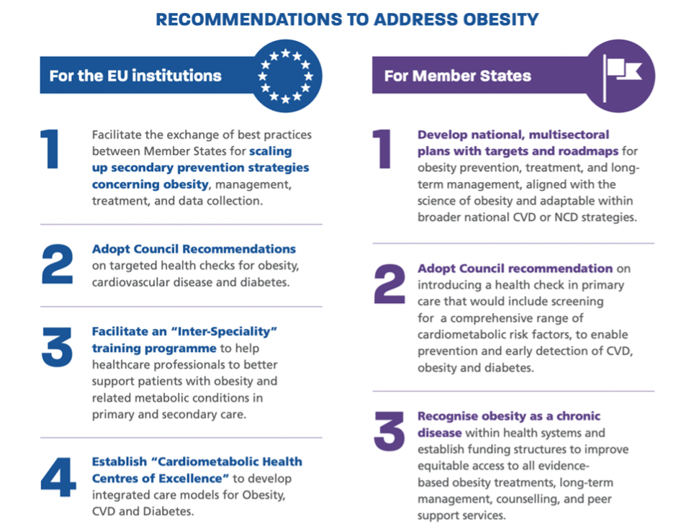
Discover our detailed proposals for tackling obesity in Europe
-
A Blueprint for Action to address Obesity in the European Union
Obesity is among the most pressing public health challenges of this century and one that is posing a significant burden on Europe’s population and health systems. It is estimated that by 2030 more than 30% of Europeans will live with obesity25.09.25Read Article -
World Obesity Day: a chronic disease demands urgent action (Guest blog)
Scientific understanding and clinical management of obesity have evolved, but attitudes, policies and societal narratives have not kept pace.04.03.25Read Article
References:
[i] Mahmood Safaei et al., (2021). A systematic literature review on obesity: Understanding the causes & consequences of obesity and reviewing various machine learning approaches to predict obesity. Computers in Biology and Medicine, vol 136, pp. 104 – 754.
[ii] Kamlesh Khunti et al., (2023). Weight change and risk of obesity-related complications: a retrospective population study of a UK primary care database. Diabetes, Obesity and Metabolism, vol.25, no.9, pp. 2669-2679. Available here. (Accessed 23/10/2025).
[iii] World Obesity Federation (2024). World Obesity Atlas. Available here. (Accessed 27/10/2025).
[iv] World Health Organisation (2022). European Region Obesity Report. Available here. (Accessed 23/10/2025).
[v] World Obesity Federation (2024). World Obesity Atlas. Available here. (Accessed 27/10/2025).
[vi] International Diabetes Federation & World Obesity Federation (2023). Policy Brief to address obesity and type 2 diabetes. (Accessed 30/10/2025). Available here
[vii] Tsigos C, Hainer V, Basdevant A, Finer N, Mathus-Vliegen E, Micic D, Maislos M, Roman G, Schutz Y, Toplak H, Yumuk V, Zahorska-Markiewicz B, Obesity Management Task Force of the European Association for the Study of Obesity Criteria for EASO-collaborating centres for obesity management. Obes Facts. 2011;4:329–333. doi: 10.1159/000331236.
[viii] Omar Shariq et al. (2020). Obesity-related hypertension: a review of pathophysiology, management, and the role of metabolic surgery. Gland Surgery, vol 9, no.1, pages 80-93.
[ix] Gregor Alexander Rindler et al., (2023). Associations between overweight, obesity and mental health: a retrospective study among European adults aged 50+, Front. Public Health, vol. 11. pp. 1-12. Available here. (Accessed 26/10/2025).
[x] Sciensano – Public Health Institute of Belgium (2023). The cost of overweight and obesity.
[xi] OECD (2019). The Heavy Burden of Obesity: the Economics of Prevention
[xii] World Obesity Federation (2022). The Economic Impact of Overweight and Obesity. The estimates for 161 countries. Available here. (Accessed 27/10/2025)
[xiii] World Health Organisation (2023). Health Service Delivery Framework for prevention and management of obesity. Available here. (Accessed 26/102024).
[xiv] Talha Burki (2021). The European Commission classifies obesity as a chronic disease, The Lancet, vol.9, no. 7. Available here (Accessed 24/10/2025).