Ensuring equal access to early cancer detection and treatment in Slovenia (Guest blog)
13.02.26
Slovenia marked World Cancer Day with its 6th Strategic Conference Living with Cancer, held at the National Council of the Republic of Slovenia - a venue that underscored the political and societal importance of cancer prevention, early detection and equitable access to care.
Slovenia marked World Cancer Day with its 6th Strategic Conference Living with Cancer, held at the National Council of the Republic of Slovenia - a venue that underscored the political and societal importance of cancer prevention, early detection and equitable access to care.
The conference was organised by the Cancer Care Working Group of the International Forum of Research-Based Pharmaceutical Companies in Slovenia, in cooperation with the National Council of the Republic of Slovenia, the Medical Chamber of Slovenia and Europa Donna Slovenia. It brought together policymakers, healthcare professionals, patient organisations and institutional representatives to discuss the introduction of new national cancer screening programmes and the patient pathway through the healthcare system.
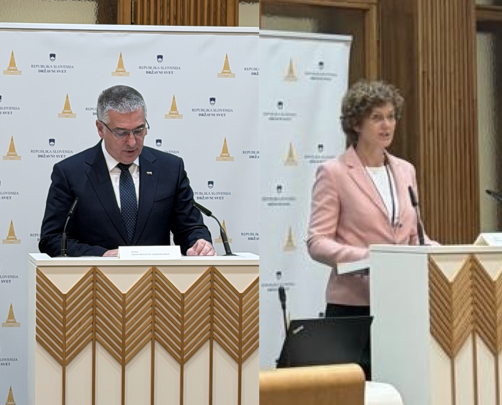
Opening the conference, Marko Lotrič, President of the National Council, highlighted that timely cancer detection is one of the key challenges of modern societies. He emphasised that while cancer does not discriminate, societies can choose whether they detect it early - pointing to screening programmes as a critical safety net that saves lives. He also underlined that Slovenia’s existing screening programmes are internationally recognised and provide a strong foundation for introducing new ones through close cooperation between policymakers, professionals and civil society.
In her address, Tjaša Burnik, President of the Management Board of the International Forum of Research-Based Pharmaceutical Companies in Slovenia, stressed that the burden of cancer in Slovenia is increasing and that improving survival and quality of life must remain a shared priority. She emphasised that early detection, screening, effective treatment and comprehensive, coordinated care are all essential components of modern cancer control - and that clinical pathways must be equally fast and effective for all patients, regardless of how they enter the healthcare system.
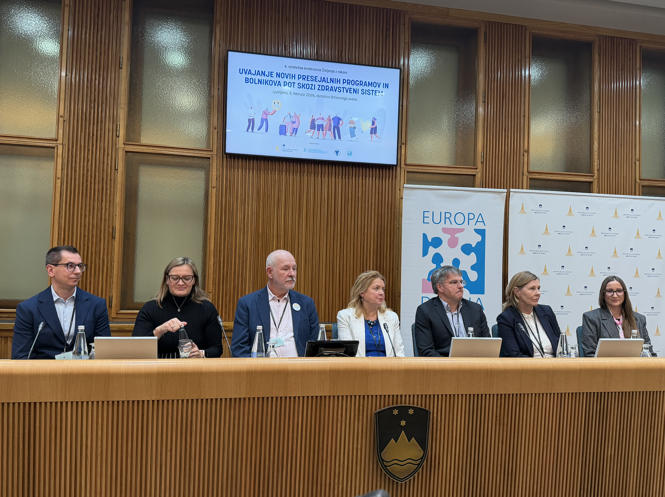
The conference focused on preparations for new screening programmes for lung, prostate and gastric cancer, building on Slovenia’s well-established national screening programmes for breast, cervical and colorectal cancer. Speakers consistently highlighted that early detection alone is not sufficient unless it is supported by integrated, well-coordinated and predictable clinical pathways.
A central message of the conference was the need to ensure equal access for all cancer patients, including those entering the system as symptomatic patients. Differences in access, coordination and waiting times can significantly affect outcomes and patient experience, particularly outside organised screening pathways.
From a professional perspective, Bojana Beović, President of the Medical Chamber of Slovenia, welcomed scientific and clinical progress that is improving survival outcomes, while cautioning that innovation also increases the complexity and workload of care delivery. She stressed the importance of long-term workforce planning and ensuring sufficient numbers of trained healthcare professionals, particularly doctors and nurses.
The patient perspective was powerfully articulated by Tanja Španić, Executive Director of Europa Donna Slovenia, who shared her personal experience of living with and beyond cancer. She highlighted how a cancer diagnosis can overshadow all other aspects of life and called for stronger collaboration between patient organisations and healthcare professionals to ensure truly patient-centred care.
Throughout the programme, speakers highlighted the importance of:
In the concluding session, Tit Albreht from the National Institute of Public Health noted that Slovenia has made important progress in cancer care but is now at a critical turning point. With a growing cancer burden, further improvements in survival and quality of life will only be possible through truly integrated, connected and patient-centred care, supported by appropriate resources, digitalisation and clear organisation of the entire patient journey.
The conference reaffirmed that early detection, equitable access and system-wide coordination are not only clinical priorities, but also strategic health-policy choices—essential to ensure that screening and innovation translate into meaningful real-world benefits for all cancer patients.
