More people are living with cancer for longer – and more young people are surviving it (Guest blog)
04.02.26
Across Europe, cancer care has been undergoing a slow but steady revolution. While the number of people diagnosed with cancer continues to rise, mortality is no longer keeping pace.
Across Europe, cancer care has been undergoing a slow but steady revolution. While the number of people diagnosed with cancer continues to rise, mortality is no longer keeping pace. The latest Comparator Report on Cancer in Europe 2025 by the Swedish Institute for Health Economics (IHE) and commissioned by the EFPIA Oncology Platform shows that the difference between cancer incidence and mortality is widening – a sign that more people are living with cancer, and living longer.
A growing but changing cancer burden
In 1995, around 2.1 million people were diagnosed with cancer in Europe. By 2022, that number had grown by nearly 60% to 3.2 million. Yet during the same period, cancer deaths increased by only 24%, from 1.2 to 1.5 million. This widening gap reflects remarkable progress in early detection, diagnostics, and treatment – and it has resulted in an estimated 22 million cancer survivors in the EU in 2020.
Even more encouragingly, new analyses presented in the Comparator Report show that actual mortality figures are even lower than previously estimated. The International Agency for Research on Cancer (IARC) had projected around 1.5 million cancer deaths in 2022, based on long-term trends. But official statistics from Eurostat show that the true number was just below 1.4 million, which is about 11% (or 100,000 people) lower than expected. This confirms that recent advances in cancer care are translating into real, measurable survival gains across Europe.
These new data also call into question earlier forecasts by the European Commission predicting that cancer would become the EU’s leading cause of death by 2035. While cancer remains the second most common cause of death overall after cardiovascular diseases, mortality trends have been stabilizing at 1.3-1.4 million deaths per year. Improved early detection and treatment may continue to offset demographic pressures from an aging population that drives much of the increase in cancer incidence.
Younger people are dying less often from cancer
Another positive finding in the Comparator Report concerns mortality among working-age people. Among those under 65, cancer is still the leading cause of death, but mortality has declined sharply. Between 1995 and 2022, the number of deaths in young adults (15 to 39 years) dropped by almost 50%, and in people aged 40 to 64 years by more than 20%.
As a result, the number of productive years lost to premature cancer death has fallen by a third since 1995. Fewer people are dying in their most active years, meaning fewer families losing a parent or partner – and more people able to continue contributing to their communities and economies.
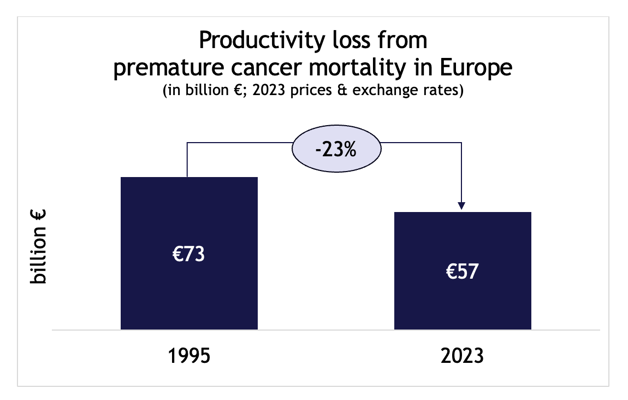
This trend also has tangible economic benefits. The report finds that productivity losses due to premature cancer deaths have declined markedly. In 1995, lost productivity from premature mortality stood at €73 billion across Europe. By 2023, this figure had fallen to €57 billion, despite more people being diagnosed with cancer.
Europe’s success in reducing cancer mortality – particularly among younger people – is both a public health and an economic achievement. The evidence is clear: investing in cancer care saves lives, strengthens economies, and secures a healthier future for Europe.
Despite the progress, there is more to do
Cancer remains the second leading cause of death in Europe, accounting for nearly a quarter of all deaths. Yet in several countries, such as Denmark, France, and the Netherlands, it has already overtaken cardiovascular diseases as the top cause – not because cancer outcomes are worsening, but because people are living long enough to develop cancer.
Behind these numbers lies a story of sustained progress: earlier detection, more accurate diagnosis, and effective treatments have transformed cancer from a fatal disease into a chronic condition for millions. Five-year survival rates across all cancer types now exceed 70% in the Nordic countries, around 10 percentage points higher than 20 years ago.
But this progress is not equally shared. The Comparator Report highlights persistent inequalities between countries in both survival rates and access to new treatments. Closing these gaps is essential to ensure that all Europeans can benefit from the same standard of care and continued innovation.
Key Takeaways:
Graph based on Figure 1 in the Comparator Report
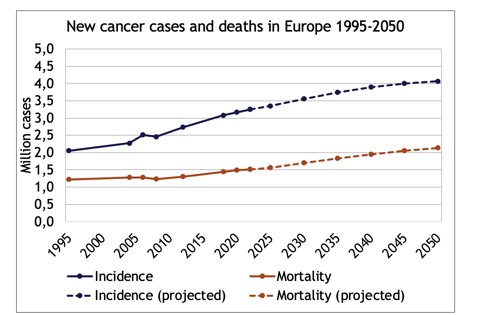
Graph based on Figure 29 in the Comparator Report