Slovenia can become a European leader in Cancer Care: Insights from Dr. Thomas Hofmarcher (Guest blog)
02.12.25
At the 2025 Tribuna of Hope, one of Slovenia’s most prominent annual gatherings of patient associations, oncology experts, and public figures, Dr. Thomas Hofmarcher (IHE) presented the latest findings from the European Cancer Comparator Report.
At the 2025 Tribuna of Hope, one of Slovenia’s most prominent annual gatherings of patient associations, oncology experts, and public figures, Dr. Thomas Hofmarcher of the Swedish Institute for Health Economics (IHE) presented the latest findings from the European Cancer Comparator Report. Published annually since 2005, the report offers one of Europe’s most comprehensive views of cancer outcomes, access, and system performance.
This year’s analysis highlights both urgent challenges and significant strengths of Slovenia’s oncology landscape — and outlines a clear pathway toward European leadership.

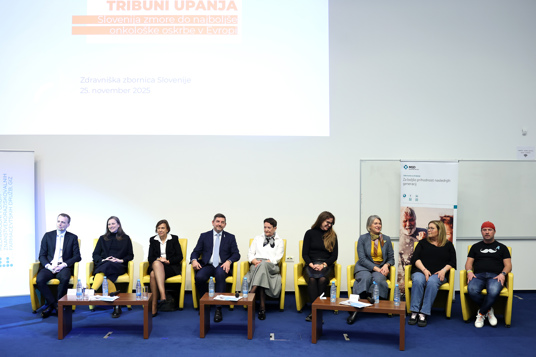
Photographer: Robert Balen
A growing burden - and a critical wake-up call
Slovenia faces one of the fastest increases in cancer incidence in Europe. Since 1995, the number of new cancer cases has nearly doubled, and in 2022 the country recorded the third-highest cancer mortality rate in Europe, measured per 100,000 inhabitants.
Yet the picture is not uniformly bleak. Dr. Hofmarcher emphasized that Slovenia has made notable gains in survival, driven by strong early detection programmes, timely diagnostics, and broad access to modern oncology medicines.
Despite dedicating only around 5% of total health expenditure to cancer care — significantly below the EU average of 7% — Slovenia achieves outcomes comparable to far larger and wealthier healthcare systems.
“Slovenia is, in many ways, a bright star of Europe,”
– Dr. Thomas Hofmarcher
“Patients have access to modern oncology medicines. The next step is consistent, year-to-year measurement so improvements can be tracked and gaps identified.”
Access to oncology medicines: A European success story
One of the most encouraging findings is Slovenia’s position among Europe’s leaders in access to innovative oncology therapies. According to Dr. Hofmarcher, Slovenia has caught up with — and in some areas surpassed — countries like Portugal and the Netherlands in the availability of modern cancer treatments.
This progress is the result of collaboration across clinical experts, cancer institutions, and patient organizations.
However, Hofmarcher also pointed to a key barrier: inconsistent annual data reporting, which weakens the ability to measure long-term performance and identify system needs.
Why is cancer rising? Key drivers identified
Several interlinked factors explain the sharp rise in Slovenia’s cancer incidence:
Despite these trends, early detection and prevention programmes have already demonstrated impact - and have the potential to achieve even more with broader participation.
Leadership, personal stories, and the power of advocacy
This year’s Tribuna brought together not only experts but also prominent voices whose personal experiences underscore the human dimension of cancer.
Photographer: Robert Balen
Dr. Aleš Musar — A voice of responsibility and courage
The guest of honour, Dr. Aleš Musar, husband of the President of the Republic of Slovenia, shared his own experience with prostate cancer. His message resonated strongly, especially among men who remain less likely to participate in screening.
“The best lesson of my story is that I don’t have a dramatic story — because screening caught the cancer early.”
– Dr. Aleš Musar
His ongoing public advocacy reinforces the importance of early detection, personal responsibility, and trust in science.
The Pogačar Family — A Symbol of hope and solidarity
Also in attendance were Marjeta and Mirko Pogačar, parents of world-renowned cyclist Tadej Pogačar. Through the Tadej Pogačar Foundation, they support oncology patients and young people affected by cancer.
Their presence brought warmth and emotional depth to the event, underscoring the role of families, athletes, and broader communities in promoting cancer awareness and prevention.
Prevention and screening: The most immediate opportunity
Dr. Hofmarcher closed his presentation with a strong and universal message:
“Your chances of surviving cancer today are dramatically higher than in previous generations. But prevention is essential. When you receive a screening invitation — go. Early detection makes the biggest difference.”
This principle applies not only to Slovenia, but to every European country working to reduce its cancer burden.
Why Hofmarcher’s findings matter beyond Slovenia
The key themes emerging from Slovenia’s experience reflect broader European trends:
Slovenia stands out as a strong case study: a smaller country that has leveraged strategic planning, patient advocacy, and early access to innovation to achieve meaningful results, even with limited funding.
Conclusion: A roadmap toward European leadership
Dr. Hofmarcher’s analysis is both a recognition of Slovenia’s accomplishments and a clear roadmap for what must come next. Slovenia possesses many of the foundational elements needed to become a European leader in oncology:
The next chapter requires consistent implementation, stronger data practices, and a national culture that embraces prevention.
“You already have many of the tools you need,”
“Now it is time to use them.”
Dr. Thomas Hofmarcher
