Biotech Act: potential to make clinical trial authorisation timelines competitive with US and China, while hospital readiness and patient recruitment still lag
24.11.26
New research by Copenhagen Economics for EFPIA provides the first comprehensive, like-for-like comparison of regulatory and ethical approval procedures and timelines in the EU/EEA under the Biotech Act, compared with the US and China.
New research by Copenhagen Economics for EFPIA provides the first comprehensive, like-for-like comparison of regulatory and ethical approval procedures and timelines in the EU/EEA under the Biotech Act, compared with the US and China.
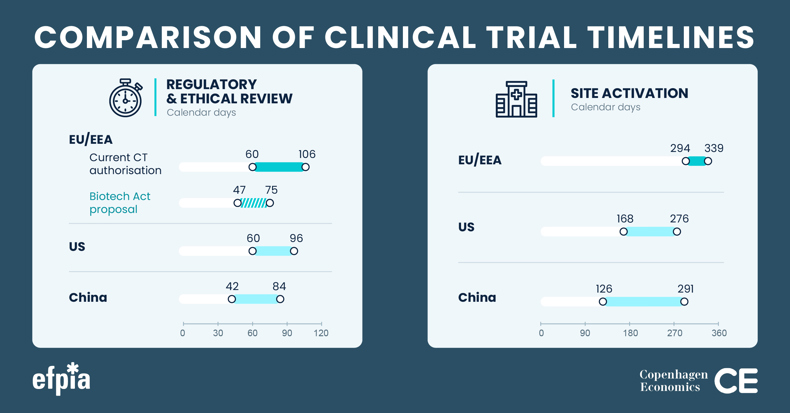
From Regulatory Submission to Clinical Trial Site Activation shows that the proposals would bring EU/EEA authorisation timelines much closer to those in the US and China. Regulatory and ethical approvals would fall from 106 to 75 days (or from 60 to 47 days without additional requests for information), compared with 96 days in the US (60 without additional requests) and 84 days in China (42 without). Delivering on these timelines under the Act should be seen as the absolute minimum goal for the EU given the wider context.
The Biotech Act targets only the Clinical Trial Application process which on its own cannot ensure that faster clinical trial approvals translate into earlier patients’ recruitment. Looking at the full process from regulatory submission to site activation, EU/EEA clinical trial sites would still take longer to activate, meaning patients’ access to trials would remain critically slow.
Overall, data shows that patients would still face waits of 294–339 days to access clinical trials in the EU/EEA, compared with 168–276 days in the US and 126–291 days in China – subject to the comparability limitations outlined in the report.
Making Europe more competitive for clinical research
The Biotech Act remains a priority – and opportunity – supported by industry, that can help boost competitiveness and encourage global investment. As negotiations progress, EFPIA is calling for even greater ambition, including a 60-day target for regulatory and ethical approval.
EFPIA and its member companies continue to call for the following measures to optimise clinical trials in Europe through the Biotech Act:
The urgency needed to catch up, and compete, with global peers is clear. The EEA’s share of global commercial clinical trials fell from 22% in 2013 to 12% in 2023. Delivering these reforms can help reverse that decline and support the EU’s goal of 500 additional multinational trials over five years, potentially enabling 35,000 more patients to participate in research.
Turning faster approvals into earlier patient recruitment
Approval is only one step towards opening a trial to patients. Regulatory reforms must be accompanied by action on site contracting, budgets, staffing, training and supply arrangements, alongside greater patient awareness of opportunities to participate. Delivery will also require sufficient resources for authorities, ethics committees and research infrastructure. Success should be measured through predictable approvals, shorter times to site activation and recruitment, and more opportunities for patients to participate across Europe.
Understanding the international comparisons
The report finds that when only citing regulatory timelines, without also accounting for ethics, it is not possible to make an absolute like-for-like comparison between the EU, US and China. For example, Copenhagen Economics finds that China’s widely cited “30-day” approval timeframe applies to a specific accelerated pathway with restricted eligibility and limited use. It should therefore not be treated as the expected timeframe for routine authorisation.
Nonetheless, China’s ambitions send a strong political signal. The country’s leadership is increasingly evident across the entire life sciences ecosystem. In 2024 it overtook the US for the discovery of new active substances, putting Europe into third place. Its current five-year strategic plan places life sciences at the very heart with targets to increase market share by 2030.
The US FDA’s Clinical Trial Innovation Pilot Program (CITIP), also known as the Trailblazer programme, also aims to accelerate clinical research by supporting innovative trial designs and more flexible, efficient approaches to generating evidence for new treatments.
With the US and China pursuing further reforms, Europe must sustain its ambition to make clinical trial approvals faster and more predictable while maintaining scientific rigour, ethical oversight and participant safety.
Nathalie Moll, Director General of EFPIA, said: “Every clinical trial brought to Europe offers patients the chance to access an innovative new therapy potentially years earlier than they otherwise might. This should be one of the major driving forces behind Europe’s ambition to attract pharmaceutical research and investment. Speeding up approvals is vital, but it is only one part of the process. This progress must be matched by hospitals ready to run trials, stronger trial infrastructure and faster patient recruitment.”
Ends