Turning EU excellence in science into commercial success could add more than €120billion to EU economy in 10 years
17.03.26
New research provides the first comprehensive overview of the EU’s attractiveness as a destination for pharmaceutical investment.
New research for EFPIA by Charles River Associates provides the first comprehensive overview of the EU’s attractiveness as a destination for pharmaceutical investment, benchmarked against its global competitors: US, China, UK and Switzerland.
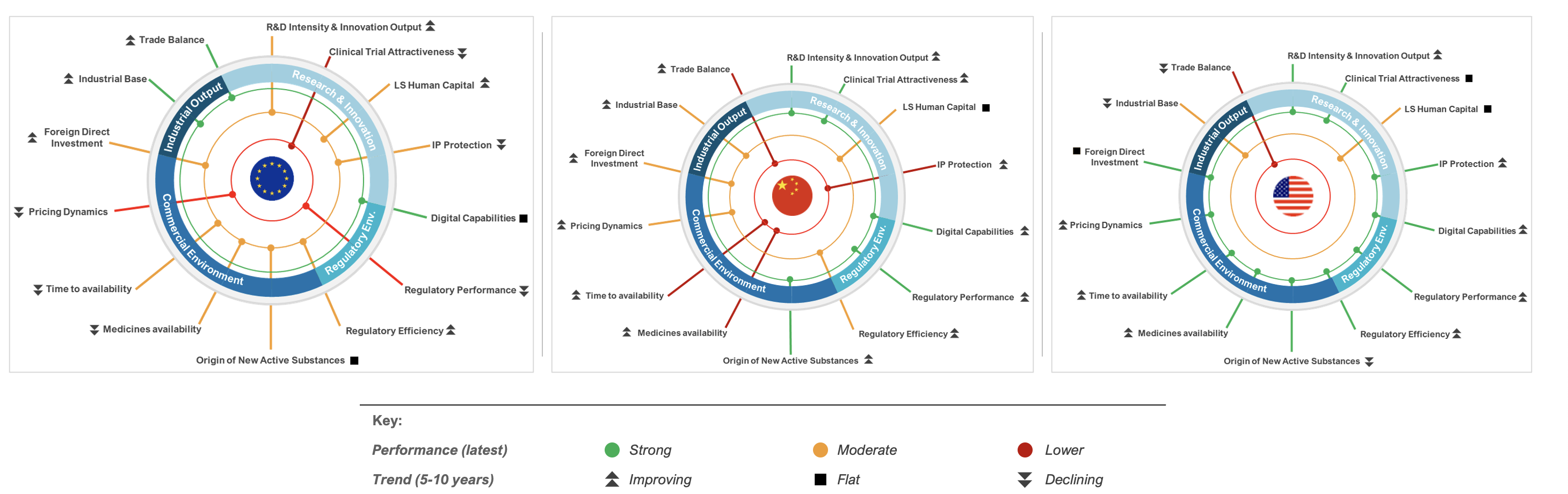
Published today by EFPIA, Assessing Europe’s Competitiveness as a Location for the Life Sciences Industry analyses 20 performance indicators across four key areas critical to attracting investment: research and innovation, regulatory framework, the commercial environment and industrial output – Europe’s complete life-sciences ecosystem.
The data underlines Europe’s continued leadership in early-stage scientific excellence, advanced digital capabilities, and pharmaceutical manufacturing, supported by a strong industrial base and trade performance.
However, the analysis also shows that Europe struggles to translate scientific excellence into research investment, clinical trials and new medicines. All of which deliver better health and economic growth.
As policymakers seek to strengthen Europe’s competitiveness, this new research helps inform the policy decisions that will shape the future of an industry integral to Europe’s health, economy and security. Each year pharmaceutical companies invest €55 billion in EU research and development, support around 2.3 million jobs and generate more than €366 billion in exports. Without the pharmaceutical industry, the EU’s overall trade balance would shift from a €133 billion surplus to an €88 billion deficit.
At the same time, recognising the strategic importance of life sciences, global competitors are moving further and faster to attract pharmaceutical investment. If Europe can match, or even exceed the pace and scale of this ambition, the report quantifies what the EU has to gain by closing the gap on its nearest rival:
Fulfilling this potential requires bold and decisive action to build on Europe’s undoubted strengths and address the issues identified in the report that are standing in the way of Europe realising its ambition to be a world leader in life sciences.
Commenting on the data, Stefan Oelrich, EFPIA President and President of Pharmaceuticals at Bayer AG said: “Europe has the science, the skills and a strong industrial base, but we’re being outpaced by China and the United States on investment, clinical trials and advancing novel medicines. Europe’s challenge is to close the gaps identified in the report to create an environment that attracts investment, accelerates translation into new treatments and ensures day-one access for Europeans. If we’re willing to act to close the gap, we don’t just boost growth; we secure Europe’s health resilience. The choice is ours.”
Nathalie Moll, EFPIA Director General said: “This report shows both the scale of the opportunity for Europe and the areas where urgent action is needed to close the competitiveness gap on other regions of the world.
With the right decisions, Europe can build on its strong scientific foundations and industrial capabilities to secure a more competitive and resilient life sciences ecosystem. Strengthening Europe’s attractiveness for pharmaceutical investment will not only support economic growth and security but also ensure that European patients benefit more quickly from the next generation of medical breakthroughs.”
Key findings from the report:
Taken from the report, below is a brief summary of Europe’s strengths and weaknesses across a number of the indicators.
EU Strengths:
EU Moderate performance:
EU Weakness: