Europe has the foundations to lead in biotech – now is the time to build on them
18.06.26
Europe is home to world-class science, talent and healthcare systems. With the right policy environment, it can become a stronger destination for innovative biopharmaceutical companies and the smaller biotech firms that drive medical innovation.
Biopharma firms are a vital source of innovation. However, the path from an idea to a medicine can be long and uncertain. Many promising products fail. Companies need funding and expertise to navigate a system that can be complex even for larger, more experienced organisations.
When they succeed, the rewards are shared not only by the people who founded the innovative company in question, but by patients and clinicians waiting for novel therapeutic options. There are tangible gains too for healthcare and for the competitiveness of the wider economy.
It’s no surprise that Europe, the US and China want to attract and keep early-stage biopharma companies. But how has this translated into concrete policies that support investment, manufacturing and commercialisation? To answer this question, we need to define and measure success. A new report by Charles River Associates (CRA) aims to do just that.
A global race for biotech leadership
The research looks at how the policy environments in Europe, the US and China shape key decisions in the biopharmaceutical sector, with a focus on the challenges faced by smaller companies in developing and delivering innovative medicines. The findings starkly illustrate the declining appeal of Europe as an investment location.
While Europe remains a global leader in scientific research, the report suggests that other regions are currently moving faster in attracting life sciences investment and supporting biotech growth. We have lost ground in several areas, from clinical trials to patent filings. It is also clear that for large biopharmaceutical companies and smaller biotech companies, the cost and complexity of operating here weigh especially heavily.
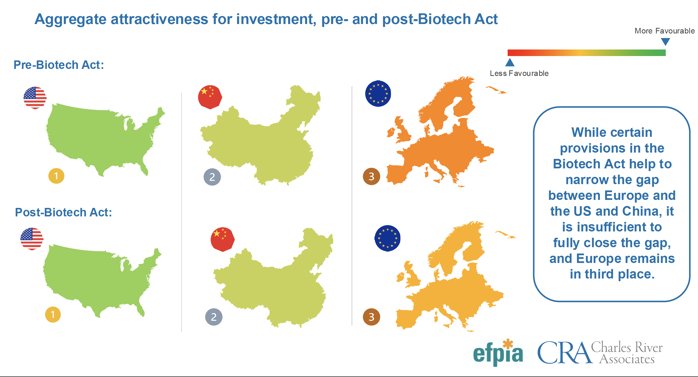
With one eye on the future, the report analyses the EU Biotech Act which seeks to simplify regulatory pathways, shorten time-to-market, and foster a more innovation-friendly environment. However, the conclusion is unambiguous: while the Biotech Act could have some positive effects, it will not be enough to bridge the gap between Europe and its biggest global competitors, the US and China.
The good news is that Europe has many of the assets needed to compete successfully. Building on these strengths through ambitious action can help make Europe a more attractive destination for pharmaceutical investment.
The CRA report looks at five key points that determines investment decisions by companies, being large or small.
1. Foundations for success
The core conditions for a successful biotech start-up include access to venture capital, intellectual property (IP) protection and regulatory incentives for early-stage companies. The US outperforms Europe on all three counts, with China ahead of Europe when it comes to venture capital funding and determined to catch up quickly on IP protections.
Globally, US firms receive the majority of biotech venture capital funding. This investment is often accompanied by access to expertise and industry networks that can be invaluable to early-stage firms.
While the report notes some of Europe’s traditional strengths in areas such as scientific research and publications, this is not translating into commercial outcomes. The US holds a strong lead when it comes to new patents. China increased its share of biotech patent filings from less than 1% to 10% between 2001 and 2020. Europe fell from 23% to 18% in the same period.
Europe's relative weakness in supporting biotech start-ups is reflected in recent trends. From 2020, 66 out of 67 EU biotech companies that went public did so by listing outside of the EU. That says a lot about how companies view Europe as a place to grow and operate.
2. Clinical development
Innovative medicines companies, large and small, have highlighted opportunities to strengthen Europe’s clinical development landscape for several years. The process can be fragmented, bureaucratic and costly, creating challenges for companies seeking to bring innovative medicines to patients.
In the US, clinical trial start-up times are shorter than in the EU, although the cost of running a trial can be higher than in some parts of Europe. However, these costs are often offset by a strong commercial environment that provides greater opportunities to attract investment and recoup R&D spending. China, meanwhile, has developed a highly cost-efficient environment for clinical research.
The impact of these challenges is becoming increasingly visible. Europe has been falling behind its global competitors in clinical development in recent years. The CRA report notes that Europe’s share of commercially sponsored clinical trials has fallen from 22% to 12% between 2013 and 2023 while China’s share has risen from 5% to 18% over the same period.
If this trend continues, it will have ramifications for our patients, hospitals and economies.
3. Setting up production
Finding technically skilled staff is a major challenge for smaller companies keen to scale up. Fast-growing companies that develop advanced therapies can struggle to build manufacturing capacity as a result, but they also lack the funds required to engage a contract manufacturing organisation (CMO).
For a biotech company, bringing its first product through clinical development and scaling up manufacturing is a long and uncertain process – all of which must be done without revenue. And, even if they success, there are more roadblocks ahead.
4. Preparing to launch Consider this statistic from the report: 78% of new drugs globally are sold in the US within one year. In Europe, the figure is 15%. It is beyond dispute that Europe’s approach to launching new medicines is particularly cumbersome.
Beyond requiring central marketing authorisation from the European Medicines Agency (EMA), companies must go through additional country-specific Health Technology Assessment (HTA) processes. Reimbursement and access systems also differ by country, generating a heavy bureaucratic burden that even larger pharmaceutical companies can struggle with.
Crucially, companies face the real prospect of securing regulatory approval without a positive decision from national HTA bodies. This is not the case in the US where, along with having faster marketing authorisation, companies do not have to prepare HTA filings.
This links directly to the final piece of the puzzle: the cost of doing business in Europe.
5. Maintaining a presence Pharmaceutical companies operating in European countries are increasingly faced with clawbacks and mandatory rebates, requiring them to return a portion of their profits. This is in addition to the cost-containment measures that some governments apply to innovative medicines. The result is downward pressure on prices and what amounts to an additional tax on profits.
Neither China nor the US imposes such limits on profitability, with inevitable implications for corporate R&D investment decisions: Europe is becoming a less appealing place to do business in a highly competitive global environment. For smaller companies reliant on venture capital, the reduced prospects of a return on investment can be devastating to their fundraising efforts.
Impact of the Biotech Act
The EU Biotech Act proposed by the European Commission in December 2025, acknowledges several of the challenges outlined above. It includes measures designed to narrow the gap between Europe and the US and China. These include welcome reforms on clinical trials and regulatory timelines, as well as broader commitments to increase public and private funding.
However, while the Biotech Act could deliver positive effects for Europe's research ecosystem, its impact on competitiveness will be limited unless it is accompanied by measures that strengthen the commercial environment.
At the same time, the US and China continue to invest heavily in strengthening their biotech ecosystems, including support for the smaller companies that are often the source of breakthrough innovation.
If Europe wants to lead, we must seize this moment to go beyond where our competitors are today. That is our best shot at shaping the future.
Discover EFPIA’s position on the Biotech Act here.
Download the report.
