Innovation in motion – Europe’s accelerating wave of new cancer medicines (Guest blog)
08.06.26
Over the past three decades, cancer treatment in Europe has entered a new era. One of the clearest signals of this transformation is the accelerating number of new cancer medicines approved by the EMA.
Over the past three decades, cancer treatment in Europe has entered a new era. One of the clearest signals of this transformation is the accelerating number of new cancer medicines approved by the European Medicines Agency (EMA). The Comparator Report on Cancer in Europe 2025 by the Swedish Institute for Health Economics (IHE) shows a marked surge in approvals, particularly over the last ten years.
This acceleration reflects deep scientific progress. Advances in molecular biology, immunology, and genomics have reshaped our understanding of cancer from a single disease into hundreds of biologically distinct entities. As a result, one-size-fits-all chemotherapy has increasingly given way to personalized treatment strategies based on targeted and immune-based therapies.
What is behind the acceleration?
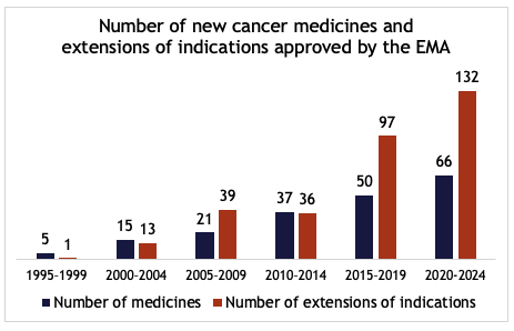
Over the last 30 years, almost 200 new cancer medicines have been approved by the EMA. In 1995–1999, around one new medicine per year was approved. By 2020–2024, the average had risen to 13 per year.
Much of this increase has been driven by targeted therapies, spanning monoclonal antibodies (mAbs), tyrosine kinase inhibitors (TKIs), and newer antibody-drug conjugates (ADCs) and bispecific antibodies (BsAbs). As tumor biology has been decoded, medicines have been developed to act on specific molecular alterations – from HER2 in breast cancer to BRAF in melanoma and EGFR in lung cancer. Improved molecular diagnostics have enabled more precise patient stratification and treatments tailored to narrower subgroups.
In addition to entirely new medicines, the EMA has approved more than 300 extensions of indications for already authorized products. These extensions – for example, use in earlier disease stages, new tumor types, or pediatric populations – are often overlooked but equally important. The sharp rise in new indications after 2015 coincides with the introduction of immunotherapies, particularly immune checkpoint inhibitors, which together accounted for almost 100 approved indications by the end of 2024.
Graph based on Figure 50 in the Comparator Report
Importantly, the trend shows no sign of slowing. Oncology has represented the largest share of the global clinical trial pipeline for at least the past decade. In 2023, oncology trials accounted for 29% of all initiated trials worldwide, up from 27% in 2018. Similarly, cancer medicines accounted for 28% of all medicines with new active substances recommended for EMA approval in 2024.
However, recent data published by EFPIA shows that approvals data for the past 18 months suggests a declining trend in the number of FDA approved medicines that are subsequently approved by the EMA, with a particularly steeply drop since October 2025. While too early to make assumptions, an uncertain EU market, poor patient access and companies prioritising the US would all negatively impact Europe’s patient access disparities. If trends persist, China might soon surpass EU for approving and launching FDA approved medicines.
Innovation and survival: A parallel story?
The report also highlights that neither new medicine approvals nor survival gains are evenly distributed across cancer types. Hematological cancers accounted for 38% of all new medicine approvals, despite representing only around 8% of new cancer cases.
This intense innovation focus on hematology appears to have paid off. Multiple myeloma is the clearest example. Over two decades, it has seen successive waves of innovation – proteasome inhibitors, immunomodulatory agents, monoclonal antibodies, CAR-T therapies, and bispecific antibodies. The cumulative effect of incremental gains has been transformative: five-year survival increased from around 30% in the mid-1990s to approximately 60% around 2020.
By contrast, some solid tumors have seen limited pharmaceutical development. Uterine cancer – the fourth most common cancer among women – did not receive a single new medicine approval between 1995 and 2020. Over the same period, five-year survival remained essentially unchanged.
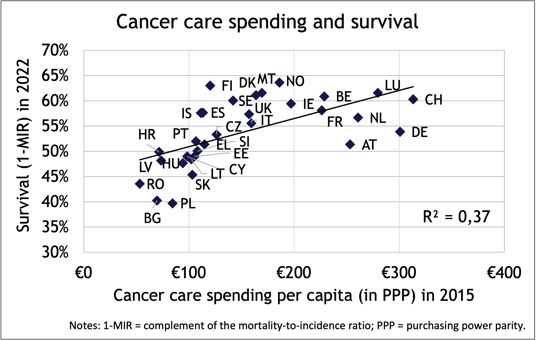
While medicines are not the sole driver of better outcomes – early detection, surgery, radiation therapy, and system performance are also crucial – the association between sustained therapeutic innovation and improved survival is difficult to ignore.
Looking ahead: The next wave of cancer medicines
If the past decades were defined by targeted therapies and immunotherapy, the next decade may be even more diverse.
Research in cancer biology continues to generate entirely new medicine classes. Novel cell-based therapies are advancing rapidly. Therapeutic cancer vaccines based on mRNA technology are already around the corner. Other emerging approaches include proteolysis-targeting chimeras (PROTACs), gene editing and gene therapy, oncolytic virotherapy, and RNA interference technologies.
These are not incremental refinements but fundamentally new mechanisms of action. The breadth of the pipeline reinforces that oncology innovation is not a temporary surge, but a structural transformation of cancer care.
The system under pressure
Rapid innovation also brings challenges. Regulatory agencies and health technology assessment (HTA) bodies are facing increasing volumes of complex applications. For example, Sweden’s HTA body, TLV, recently reported that its workload for cancer medicine evaluations has grown substantially and that capacity is strained.
The policy question is therefore not whether innovation should slow – few would wish for fewer breakthroughs – but how to ensure that rapid development translates into equitable and sustainable patient benefit. As the report indicates, a major challenge lies in the timely uptake of new medicines into clinical practice – a topic to be explored in a future blog post.
Key Takeaways:
Related blogs
