Japan's 2026 Honebuto offers a blueprint for Europe's pharmaceutical competitiveness
03.08.26
While Europe continues to debate how to strengthen its competitiveness, Japan is acting.
While Europe continues to debate how to strengthen its competitiveness, Japan is acting. The strategic relationship between Government and Industry to jointly identify competitiveness challenges and shape strategy should be an aspiration for the EU.
The adoption of Japan’s 2026 Basic Policy on Economic and Fiscal Management and Reform (Honebuto) sends a clear message that life sciences are not simply part of the healthcare system, they are an economic asset. More than an annual fiscal policy document, the Honebuto sets the government’s key priorities and places pharmaceutical innovation at the heart of Japan’s growth strategy.
A few messages stand out.
Japan is committed to doubling down on pharmaceutical innovationThe Honebuto commits to strengthening the country’s life sciences ecosystem through sustained investment in R&D, manufacturing and innovation. It also calls for policies that would enable the market for patented innovative medicines (including first-in-class and best-in-class products) to grow at a rate comparable to the 9.6% average growth observed across other G7 markets.
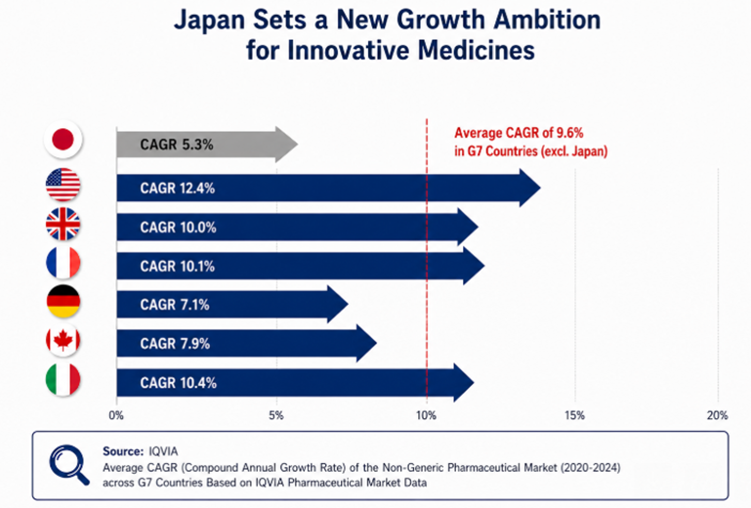
To achieve this, Japan is committed to further consider how to better reward innovation by enhancing pricing for patented medicines at initial National Health Insurance (NHI) listing and maintaining appropriate pricing throughout the patent period. This sends an unmistakable message that Japan sees innovative medicines as a strategic investment in economic growth, resilience and long-term competitiveness. The next step is for Japan to ensure that implementation of the Honebuto fully reflects its competitiveness ambitions, including by better aligning initial prices with U.S. market conditions and by removing mechanisms that erode prices during the patent period.
Competitiveness is shaped globallyFor the first time, the Honebuto recognises the potential impact of U.S. Most-Favored-Nation (MFN)-based pricing policies on Japan’s attractiveness for pharmaceutical innovation. It acknowledges that changes to global pricing dynamics can influence where companies invest, conduct clinical trials and launch new medicines. In today’s world, pharmaceutical competitiveness is no longer determined by domestic policy alone. Decisions taken in one major market increasingly shape investment decisions across many others.
Europe has a choice
Perhaps the most valuable lesson from Japan is not what it decided, but how it got there. Through its Public-Private Council, Japan has created a permanent forum where government and industry jointly identify competitiveness challenges and shape national strategy.
Rather than asking industry to respond to predetermined policy agendas, policymakers work with industry to understand what is needed to attract investment, innovation, and manufacturing.
Adopting the same mindset in the EU could help shape a European Pharmaceutical Taskforce, bringing together the European Commission, Member States and industry to provide the strategic platform needed to align health, industrial and trade policy behind a shared competitiveness agenda.
The case for action is compelling
The research-based pharmaceutical industry is one of Europe’s greatest strategic assets. The sector invested €60 billion in R&D in Europe in 2025, supports 2.3 million jobs, and is the EU’s largest contributor to its external trade balance. Without pharmaceuticals, the EU’s €133 billion trade surplus in 2025 would have become a €93 billion trade deficit. Every €1 invested in innovative medicines generates €5.67 in economic and societal value.
If Europe can create the conditions for innovation, investment, manufacturing and trade its economy will flourish; the alternative is to continue to see research, capital and talent gravitate elsewhere.
Japan has made its choice. Europe must now decide its own path.
