Know Your Numbers by age 35: A new standard for cardiovascular care in Europe
30.07.26
Investing in well-designed cardiometabolic health checks linked to care pathways would significantly reduce burden of cardiovascular disease in Europe.
Investing in well-designed cardiometabolic health checks linked to care pathways would significantly reduce burden of cardiovascular disease in Europe.
Cardiovascular disease (CVD) is often discussed through statistics, targets, and system costs. Those figures are important, but they can sometimes obscure a simple reality: across Europe, almost everyone will know someone affected by heart disease, stroke, diabetes, obesity, or high blood pressure. Earlier detection and better prevention can make a meaningful difference, not only for individuals at risk but also for families, communities, and health systems.
This is why the EU Safe Hearts Plan, published in December 2025, matters so much. It aims to tackle Europe’s biggest disease. The case for urgent action is clear. Cardiovascular diseases are responsible for 1.7 million deaths in Europe annually. Another 60 million people are directly affected, with economic costs of more than €282 billion per year.
EFPIA supports the Plan's ambition to reduce premature cardiovascular mortality by 25% by 2035. The challenge now is its implementation. Political commitment needs to be translated into practical measures that reach citizens, detect risk earlier and ensure timely intervention. A core component of the Plan is the proposal for a Council Recommendation setting out an EU protocol on Cardiovascular Health Checks, in order to improve timely detection and early diagnosis of CVD, diabetes and obesity.
Just as importantly, the Plan recognises that protocols only make a difference when they are put into practice. Implementation support and pilot projects will be essential to ensure higher uptake of screening and help health systems move from treatment towards prevention of the disease.
This shift could save thousands of lives. Up to 80% of CVD cases are preventable through early detection and better control of risk factors. Health checks are therefore a golden opportunity to give European citizens the information, support and care they need. Importantly, the Safe Hearts Plan represents a shift away from blaming citizens for developing cardiovascular disease and towards empowering them with the knowledge, tools and care pathways needed to understand and manage their risk. Prevention works best when people are supported, not judged.
Turning momentum into action
There is now real momentum behind health checks, both politically and clinically. However, while several countries are already conducting regular checks, others are at an earlier stage and are actively discussing how best to implement the Safe Hearts Plan in a way that fits their national context.
To help strengthen the evidence base and share practical examples of what actually works, the EFPIA Cardiovascular Health Platform commissioned an independent study by PwC on the value of health checks. The study offers a structured and comprehensive review of the clinical, economic and societal value of cardiovascular health checks, based on literature and real-world programme experience.
The evidence shows that cardiovascular health checks improve the diagnosis of hypertension, dyslipidaemia, diabetes, obesity and chronic kidney disease. Crucially, this translates into better outcomes for patients. In the UK, for example, the NHS Health Check was associated with 15% lower rates of heart attack and 23% lower mortality.
But the report also makes one point very clear: health checks are not just about testing. The real value comes from knowledge and what happens next. A person who discovers they have high blood pressure, high cholesterol, elevated blood sugar, or another risk factor needs more than a result. They need a clear route into follow-up care, treatment where appropriate, and long-term risk management in line with clinical guidelines.
As an example, early detection can be particularly valuable for identifying inherited conditions such as familial hypercholesterolaemia (FH), which often remains undiagnosed despite substantially increasing the risk of premature cardiovascular disease. Timely diagnosis can enable earlier treatment and cascade screening of family members, helping to prevent avoidable cardiovascular events across generations.
The economics of health checks: generating strong ROI
The economics of health checks is becoming clearer. Health checks have the potential to deliver a positive return on investment (ROI) over time, especially when programmes are targeted and implemented effectively. Available evaluations indicate that net financial savings accrue gradually as prevented cardiovascular events reduce subsequent healthcare utilisation, generating long-term savings.
For instance, modelling suggests ROI for the UK’s NHS Health Check programme will become positive by 2040, with an estimated long-term return of £2.93 for every £1 invested compared with a scenario in which no programme exists.
Building on what works
The PwC report highlights examples from across Europe where cardiovascular health checks have already been introduced. Not only do these cases illustrate that several countries have a strong foundation on which to build, but they provide lessons, inspiration and insights on how they can work in practice.
These programmes show that prevention is not an abstract ambition, but something that can be organised, delivered and scaled when health systems make it easy to access and clearly connected to care.
Raising standards across Europe
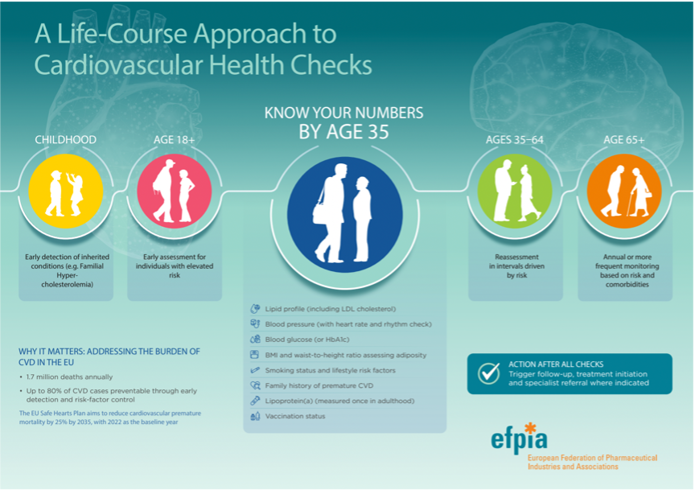
The upcoming Council Recommendation on Cardiovascular Health Checks is a once-in-a-generation opportunity to establish a new standard for cardiovascular prevention in Europe: every citizen should know their numbers by the age of 35[1], with a comprehensive cardiometabolic risk assessment, followed by regular reassessment throughout life.
Age 35 represents a critical point at which cardiovascular risk factors frequently begin to emerge while preventive interventions remain highly effective. Establishing an early baseline can identify elevated risk decades before a first cardiovascular event.
To support a more consistent standard of care across Member States, the Recommendation should provide clear and ambitious guidelines on what cardiometabolic health checks should include. These checks should cover lipid profile, blood pressure, blood glucose, obesity indicators, smoking status, family history of premature CVD, Lipoprotein(a) (once in a lifetime), and vaccination status against relevant respiratory infections.
However, knowing the numbers is only the first step. People also need to know what those numbers mean and what to do next. This is why health checks must be linked to appropriate action. The Recommendation should therefore include clear referral and follow-up pathways, ensuring that screening results systematically trigger appropriate treatment, specialist referral where necessary, and long-term management.
Investing in healthier lives and stronger, sustainable health systems For decades, Europe made progress in reducing illness and death from CVD. In many countries, that progress has now stalled. This should not be accepted as inevitable. We have the knowledge and the tools and the evidence, to identify risk earlier, intervene sooner and help millions of people live longer, healthier lives.
The Safe Hearts Plan provides a clear vision for the future of cardiovascular prevention in Europe. The forthcoming Council Recommendation is a unique and unprecedented opportunity to turn that vision into reality by making health checks a cornerstone of prevention and ensuring that every European has the chance to know, understand and manage their cardiovascular risk.
Success will see the benefits extend far beyond cardiovascular health. We can help people stay healthier for longer, reduce pressure on health systems, strengthen economic resilience and create a healthier future for generations to come. Knowing your numbers by 35 is a simple idea. But if Europe commits to making it real, it could become a new standard for saving lives.
References:
[1] https://www.escardio.org/news/news-room/recommendations-for-eu-wide-cardiometabolic-health-checks/

