EFPIA ONE's Vision
Delivering safer, better medicines to patients - faster than we've ever done before
A regulatory system fit for the next generation of treatments
At EFPIA we are working to discover and develop innovative therapies, to deliver people the treatments they need, and eventually ensure a healthier future for European patients. Developing new medicines is a long, complex and risky process with no guarantee of success.
The regulatory framework is the process that allows to take this idea for a new treatment through clinical trials and tests to ensure it’s safe and effective, all the way through the final authorisation, before it can be made available to patients.
The European regulatory system has done great so far. For instance:
- It served patients: Since its foundation in 1995, the European Medicines Agency has recommended the authorisation of nearly 2,000 new medicines.
- It supported investments: It has helped to attract the €60 billion that the pharmaceutical industry invests in European research and development every year. Investments are needed to ensure continuous innovation of new treatments.
But medical innovations are becoming increasingly complex. From products that combine medicines with devices or diagnostics to cell and gene therapies, patients and health systems can look forward to better outcomes in a wide range of disease areas. At the same time, global competition is intensifying, and other regions are moving faster to attract life sciences investment.
An efficient and agile regulatory framework is essential for Europe’s competitiveness. To remain a leading location for developing and launching new medicines, Europe’s regulatory framework must evolve.
ONE Vision: from fragmentation to one integrated system
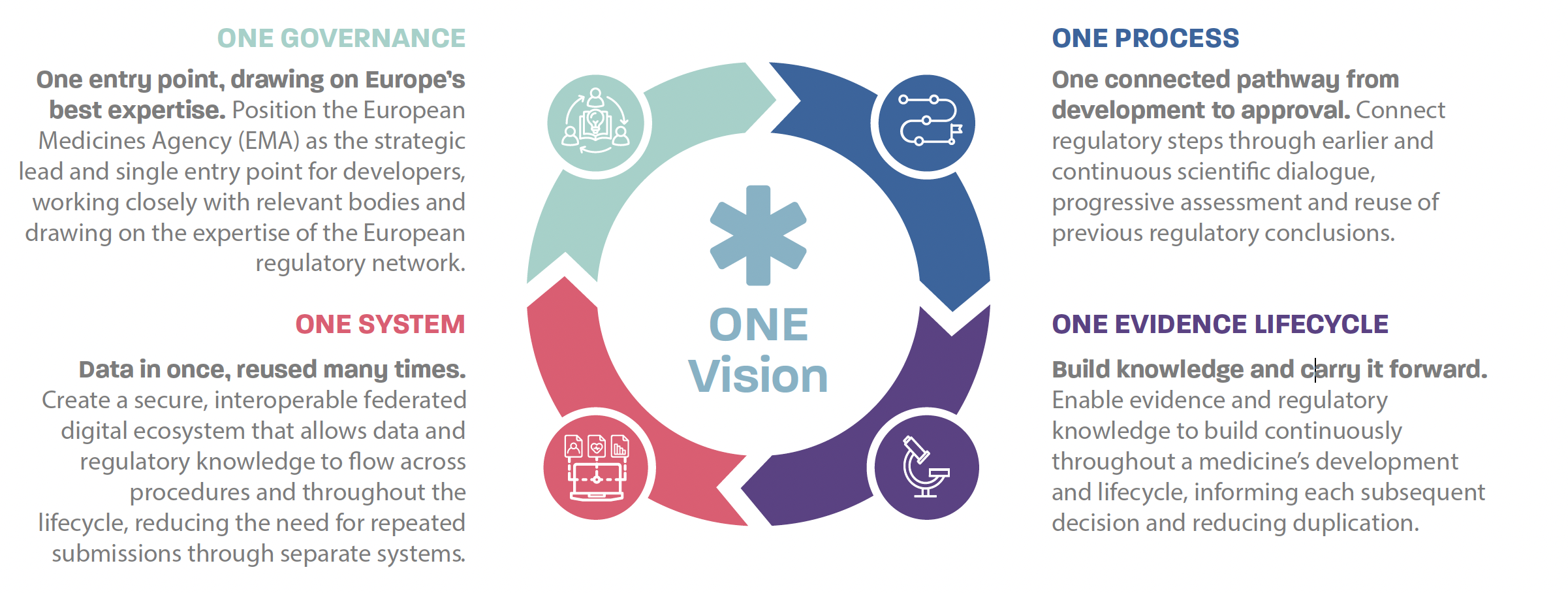
ONE Vision is EFPIA’s proposal for a connected and integrated EU regulatory system, bringing development, authorisation and lifecycle management together so that knowledge and evidence build progressively and carry forward.
Watch our videos
Listen to our podcasts
Regulatory Road to Innovation Experts' Insights
-
A modernised EU Variation Framework for enhancing the life of European patients
Regulatory Road to Innovation16.03.23Read Article -
Dynamic Regulatory Assessment will support more efficient treatment development for patients: the time to pilot is now (Guest Blog)
Regulatory Road to Innovation02.03.23Read Article -
How Regulation Can Boost the EU Innovation?
Technology moves fast. An agile and streamlined innovation ecosystem would make Europe more competitive and bring breakthroughs to patients.23.02.23Read Article -
Real-world data/evidence: How it can inform patient treatment and care decisions (Guest Blog)
Regulatory Road to Innovation09.02.23Read Article -
A sustainable environment for a healthy population (Guest Blog)
There is strong agreement between Bengt Mattson and Andreas Haener, chairs of the Interassociation Industry Pharmaceuticals in the Environment Task Force (IAI PiE TF) – industry has taken big steps over the past decade to combat the impact of pharmaceuticals in the environment.23.01.23Read Article -
Digital endpoints for patient-focused health management
Besides providing more precise and accurate assessments, digital endpoints could significantly decrease the time and costs related to trial participation, predominantly for persons with physical or time limitations.30.11.22Read Article -
Electronic Product Information (ePI) – Making the latest medicine’s information available for patients without any delay
Increasing access to medicines information and to the most updated regulator-approved information.02.11.22Read Article -
Expedited regulatory pathways: A toolbox to provide innovative medicines to patients
For Europe to stand its ground amongst other international regulatory authorities, it is crucial to evolve and future-proof EU expedited regulatory pathways.05.10.22Read Article -
The future treatment of patients - Combination Products and Companion Diagnostics (Guest blog)
Regulatory Road to Innovation14.09.22Read Article -
Supply Chains reshaping - How to respond to a crisis
#RegulatoryRoadtoInnovation23.06.22Read Article -
Complex Clinical Trials – A decade of innovation in clinical research
From a Drug centric to a Patient centric approach19.05.22Read Article -
EU Regulatory Network - New Architecture for a New Era (Guest blog)
Imagine you built a house. It was not big, but sufficient for what you needed at the time. Over the years, your family grew, and that same house was not sufficient anymore. You realize you need to renovate so that it fits your current and future needs.28.04.22Read Article
[1] European Commission, Union Register of medicinal products for human use.
[2] EFPIA, The Pharmaceutical Industry in Figures, 2019